The core of a DC cooling fan is driven by a brushless DC motor (BLDC), which relies on electronic commutation to replace traditional carbon brush commutation. It has the characteristics of high efficiency, low noise, and long life. Its working principle can be disassembled into four key links: core structure, electromagnetic drive, electronic commutation, and speed control. The specific steps are as follows:
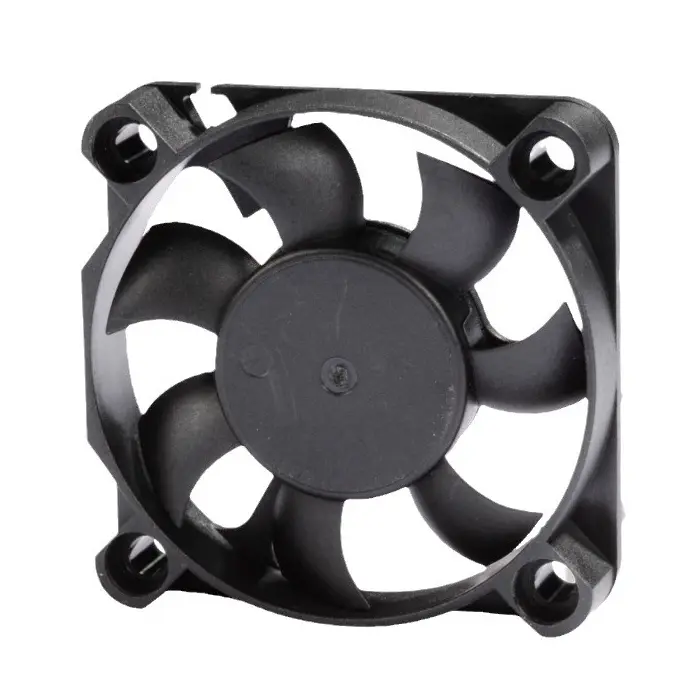
1、 Core structure composition The brushless motor of a DC cooling fan is mainly composed of three core components: stator (stationary part), rotor (rotating part), and electronic commutator (driving circuit), all of which are indispensable: stator Composed of an iron core and multiple sets of winding coils, the iron core is usually made of stacked silicon steel sheets to reduce electromagnetic losses; The winding coils are wound on the iron core slots at a certain phase angle (usually 120 °) to form a three-phase stator winding (there are also two-phase and single-phase designs, with the best three-phase performance). rotor It is the rotating component of a fan, including permanent magnets (mostly neodymium iron boron magnets), shaft, and fan blades. The permanent magnet is fixed on the rotor housing, forming a magnetic field with alternating N and S poles. The rotating shaft is connected to the fan blades, driving the airflow. Electronic commutator (driver board) This is the "brain" of a brushless DC fan, which integrates Hall sensors, power switching transistors (MOS transistors), and control chips. Hall sensor: responsible for detecting the position of the rotor permanent magnet and outputting position signals; Power switch tube: controls the energizing sequence and current magnitude of the stator winding; Control chip: receives Hall signals, drives the switching transistor to conduct/turn off according to a regular pattern, and achieves electronic commutation.
2、 Electromagnetic drive and electronic commutation principle (core link) The rotational power of a DC cooling fan comes from the interaction force between the stator magnetic field and the rotor permanent magnetic field, and electronic commutation is the key to maintaining continuous rotation. The specific process is as follows: Initial electrification and establishment of magnetic field When the DC power supply is connected to the drive board, the control chip first detects the initial position of the rotor permanent magnet through a Hall sensor (such as a magnetic pole facing a certain winding of the stator). The winding is energized in an orderly manner, generating a rotating magnetic field The control chip drives the power switch tubes to conduct in a specific phase sequence based on the Hall signal, allowing direct current to flow into the three-phase stator windings in sequence. When current passes through the winding, an electromagnetic field with a fixed direction is generated according to Ampere's law. For example, by first energizing the A-phase winding, the generated stator magnetic field and rotor permanent magnetic field form a force that attracts opposite magnetic poles and repels same magnetic poles, pushing the rotor to rotate a small angle. Real time commutation to maintain continuous rotation When the rotor rotates to the next position, the Hall sensor immediately detects the magnetic pole change and feeds back the signal to the control chip. The control chip immediately switches the conduction sequence of the power switch tube, switches the energization phase of the stator winding, and synchronously "rotates" the direction of the stator magnetic field, continuously generating thrust on the rotor. The cyclic process of "detecting magnetic pole position → switching winding power on → rotor rotation → re detection" is electronic commutation, which replaces the traditional brush commutation of brushed motors and avoids the problem of carbon brush wear.

